
Introduction
Voice recognition technology, also known as speech-to-text, has evolved considerably over the past few years. With the rise of voice artificial intelligences such as OpenAI's Whisper and Meta's wav2vec, the industry has seen a substantial improvement in multilingual capabilities and accuracy. These advances have enabled a deeper integration of voice recognition systems into various aspects of everyday life, from personal assistants to complex professional applications.
As we move toward the end of 2025, it becomes crucial to understand how these technologies have developed, what their current applications are, and what challenges remain to be addressed. This article aims to provide a comprehensive overview of the progress made in the field of ASR, focusing in particular on the major contributions of Whisper and wav2vec, as well as on the future trends that will transform the way we interact with machines.
Background/History
Voice recognition made its debut in the 1950s with systems capable of recognising a few simple words. Since then, progress has been exponential, with significant developments in the 1990s thanks to the increase in computing power and the emergence of neural networks. The 2010s saw the integration of deep learning, which improved the accuracy and linguistic diversity of ASR systems.
The introduction of models such as Whisper and wav2vec marked a turning point in the history of voice recognition. In 2023, Whisper was praised for its ability to handle low-resource languages with great accuracy, while wav2vec paved the way for better recognition in noisy environments and across different accents and dialects.
Sources: wav2vec 2.0 — arXiv 2006.11477, June 2020 · Whisper — arXiv 2212.04356, December 2022
Applications/Use Cases
The applications of voice recognition technologies are vast and varied, ranging from personal assistants such as Alexa and Google Assistant to automatic transcription tools for journalism and customer service, as well as specialised cloud services such as Microsoft's Azure AI Speech and Google Cloud Speech-to-Text. In the healthcare sector, voice recognition simplifies clinical documentation, allowing professionals to focus more on patient care.
In the field of education, ASR systems facilitate accessibility for hearing-impaired students and provide automatic transcriptions of lectures, thereby enriching the learning experience. In the transport sector, voice commands improve driver safety and convenience, while in the financial industry they speed up transactions and enhance the user experience.
These professional uses connect directly to the work of Koaee, which designs multilingual conversational assistants for businesses. Voice recognition serves customer relations there in sixteen languages, relying in particular on Mistral's Voxtral for voice and on OpenAI's GPT models for language understanding. The infrastructure is hosted on servers in Europe and no conversation is retained.
Technologies/Methods
The technologies underlying modern voice recognition systems are based on advanced deep learning architectures. OpenAI's Whisper uses transformer models that enable improved contextual understanding, essential for complex languages and dialects. Meta's wav2vec 2.0 relies on self-supervised learning, which allows it to learn voice features without requiring large amounts of labelled data.
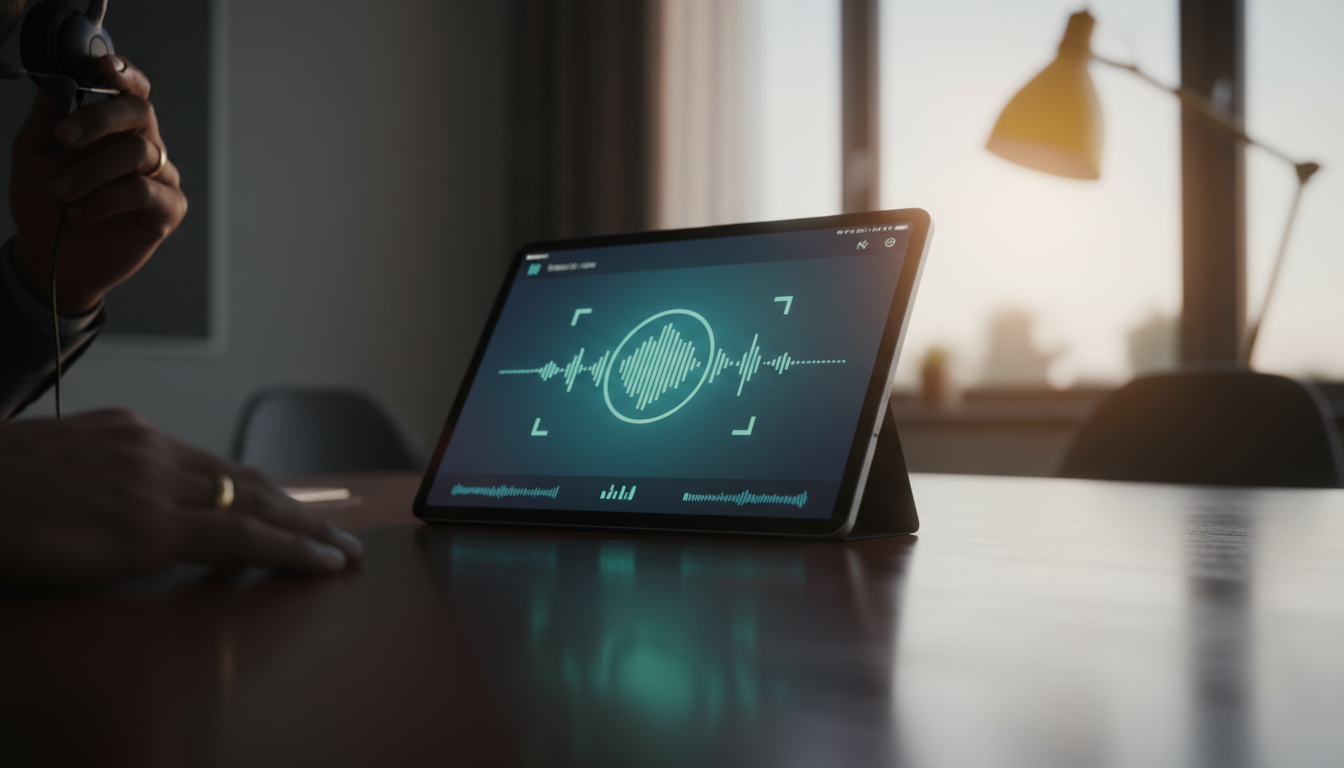
Integration with large language models (LLMs) is a growing trend, enabling better contextual interpretation and increased transcription accuracy. This combination of technologies offers real-time processing capabilities with reduced latency, essential for mobile and Internet of Things (IoT) applications.
Challenges/Limitations
Despite the advances, several challenges remain in the field of voice recognition. Handling noisy environments and accent variations remains a persistent problem, although progress has been made with self-supervised approaches such as wav2vec 2.0. Issues of privacy and security of voice data are also of concern, particularly with regard to the storage and analysis of sensitive personal information.
Moreover, equitable access to these technologies for underrepresented languages and users in remote regions is a major challenge. Efforts to reduce biases in AI models and improve inclusivity continue to be a priority for developers and researchers.
Outlook
The future of voice recognition is promising, with prospects for continuous improvement in multilingual capabilities and reduction in computing costs. The rise of edge computing offers opportunities to deploy faster and more secure ASR systems on personal devices, thereby minimising the risks of privacy violations.
Multimodal integrations, combining audio, text and visual data, are expected to strengthen contextual understanding and enrich human-machine interactions. In the long term, voice recognition systems could evolve toward even more natural and intuitive forms of interaction, transforming the way we perceive and use digital technologies.
Conclusion
In summarising the progress made in the field of voice recognition, it is clear that technologies such as Whisper and wav2vec play a crucial role in improving the accuracy and reach of ASR systems. Despite persistent challenges, current trends point to a future where voice recognition will be increasingly integrated into various aspects of everyday life, making the technology more accessible, secure and inclusive.
Source: Eurostat, “Artificial intelligence by size class of enterprise” (isoc_eb_ai) — enterprises with 10–249 employees, France. Retrieved via API on 30 August 2026. The survey publishes neither 2022 nor 2026: the series stops at the latest available year.
Sources
Journal of AI Research
MarketsandMarkets
Facebook AI Research
OpenAI
Microsoft Azure